
(radiotamazuj.org)
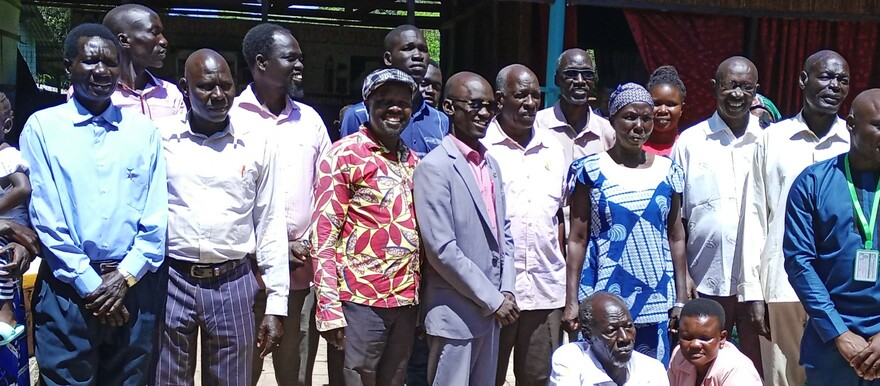
Participants in a consultative workshop for land administrators in Torit, the capital of South Sudan’s Eastern Equatoria State, have expressed confusion over the statement “land belongs to the people of South Sudan” as outlined in the proposed land policy. They have collectively decided that the phrase should be amended to “land belongs to the community.”
This consensus emerged during a one-day consultation workshop organized by the South Sudan Land Alliance, with the support of the United Nations Food and Agricultural Organization, on Thursday. The primary objective of the workshop was to gather the perspectives of land administrators regarding their roles and responsibilities, which will inform the national land policy.
With over 30 attendees, including local government officials, lawmakers, civil society groups, and religious leaders, the participants raised concerns that the current wording used by the National Ministry of Land is perplexing. They fear it could potentially serve as a tool for land grabbing in the future.
“They recommended a thorough examination of the phrase ‘land belongs to the people’ in the national land policy document. This particular expression has been a source of contention in discussions across all five states,” explained Wodcan Saviour Lazarous, the Secretary General for South Sudan Land Alliance and the Executive Director for Support Peace Initiative Development Organization (SPIDO).
“People are still grappling with the meaning of this phrase. When we refer to ‘people,’ who exactly are they, and where do they come from? The individuals we have engaged with express the need for clarity and a precise definition. They want a clear understanding of why land belongs to the people rather than the community. It is crucial for this to be explicitly addressed in the national land policy document,” he emphasized.
He added,“I think what comes in their minds is that they look at it as a political statement whereby some individuals use that phrase when settling in other people’s land by force,” noted Wodcan.
“In other words, it is a political statement that can facilitate land grabbing. Eastern Equatoria, recently affected by conflicts between cattle herders and farmers, sees this phrase as reminiscent of those issues. People interpret it as a means of forcing individuals to settle on land, rather than a legitimate way of acquiring it,” Wodcan concluded.
Several resolutions emerged from the discussion, addressing additional training for land administrators and the establishment of grassroots land committees, including state-level land commissions, to address land issues more effectively.
Abdallah Hassan Famai, the Director General in the Eastern Equatoria State Ministry of Local Government and Law Enforcement Agencies, expressed concern about the drafting of the land policy in Juba without prior consultations at the grassroots level.
He believes this approach is unlikely to work for the majority and emphasized the importance of incorporating customary laws into the land policy to prevent future conflicts.
“We have customary laws differing from one community to another, especially on the issue of land. Some communities have landlords, and others don’t have, and those that have landlords have certain rules on how to administer or manage the land, and to others, they consider the land belongs to their community as a whole,” Hassan elaborated.
Highlighting the need for a comprehensive approach, Hassan emphasized, “We have to include the views of the people from the grassroots and across different ethnic groups who have different land ownership and management systems. We need to find out how they can respond to the position of the government if that government wants land.”
Jeff Ikachilla, a member of the Eastern Equatoria State Legislative Assembly, has voiced support for the ongoing consultations, anticipating that a well-crafted land policy will help resolve widespread land disputes in the region.
Addressing the issue of cultural laws that inhibit female inheritance of land, Ikachilla emphasized the importance of incorporating changes into the land policy. “I believe we should incorporate into the land policy the right of a female family member to inherit her father’s possessions. Additionally, a female community member should have the right to own land simply by virtue of being a member of the community,” Ikachilla said.
Elaborating on the rationale behind his stance, the lawmaker highlighted the positive contributions women make to their communities. He argued, “Women contribute positively to the betterment of their communities; they should have full rights.”
The National Land Policy, drafted in April, outlines principles for land governance, addresses key challenges, and establishes an institutional framework for responsible land governance. Once adopted, it will form the basis for sector policies to drive economic development.
South Sudan grapples with challenges in land administration, such as unclear land ownership, weak management, conflict-induced displacement, gender bias, and issues related to agriculture and sustainable resource management. Additional concerns include land use planning, environmental conservation, informal settlements, conflicts between pastoralism and farming, as well as land grabbing, illegal occupations, boundary disputes, and the impacts of climate change and natural disasters.
Newer articles:
- Sudan war forces Rizeigat community to sell livestock in South Sudan - 13/11/2023 03:56
- OCHA - Sudan Crisis Is 'Verging On Pure Evil' - 13/11/2023 03:10
- Kiir in Riyadh for Saudi-African summit on Sudan peace - 10/11/2023 08:31
- South Sudan: Unshattered hope in the face of adversities | Médecins Sans Frontières - 10/11/2023 06:50
- Two Twic youth trapped in Abyei freed - 10/11/2023 06:49
Older news items
- The UK has a key role to play in fighting for peace in Sudan - 10/11/2023 03:38
- Mathuki: Somalia could join EAC this month - 10/11/2023 01:44
- South Sudan ready to take chairmanship of the East African Community - 09/11/2023 06:13
- Global charity urges for funding to help fight food crises in South Sudan - 09/11/2023 05:11
- ‘Black Panther’ Star Lupita Nyong’o Joins Sudan’s Oscar Submission ‘Goodbye Julia’ as Executive Producer - 09/11/2023 04:20
Latest news items (all categories):
- Canada helping to fund South Sudan vote despite growing repression - 05/10/2026 15:10
- UNMISS patrol reaches remote Ibba communities amidst heavy rains, insecurity, and growing health threats - 05/10/2026 15:07
- WFP Strongly Condemns Attack on Trucks in South Kordofan, Killing One Driver - 05/10/2026 15:03
- Advancing Women’s Land Rights through building capacity of customary institutions in Magwi County, South Sudan - 02/10/2026 13:18
- AU calls for release of political detainees ahead of South Sudan elections - 02/10/2026 13:15
Random articles (all categories):
- Vaccination campaign aims to reach over 2.8 million children with monovalent oral polio vaccines in South Sudan - 25/02/2021 01:02
- Multiple vacancies with UNICEF South Sudan - 12/10/2022 12:11
- Video: Two new roads in Lakes State show way to food security - 10/10/2011 11:06
- SUDAN - Social crisis, a coup is feared: for the Bishop of El Obied, the "future is uncertain" - 23/10/2021 08:05
- South Sudan’s warring parties set to escalate fighting ahead of rainy season: report - 14/04/2015 17:00
Popular articles:
- Who is the darkest person in the world, according to Guinness World Record? - 25/10/2022 02:34 - Read 150521 times
- School exam results in South Sudan show decline - 01/04/2012 17:58 - Read 28178 times
- Top 10 weakest currency exchange rates in Africa in 2023 - 19/07/2023 00:24 - Read 25293 times
- No oil in troubled waters - 25/03/2014 15:02 - Read 24521 times
- NDSU student from South Sudan receives scholarship - In-Forum - 29/09/2012 01:44 - Read 22478 times
