
German Health Minister Jens Spahn touched down in South Africa on Friday, as part of a trip focused on assisting local vaccine production.
French President Emmanuel Macron was also due to attend the kickoff meeting in Pretoria, which was set up following announcements last week by the European Union at a G20 health conference in Rome supporting the production of and access to vaccines in Africa.
Earlier this month, the World Health Organization (WHO) expressed its concern that African countries were running out of vaccines, advising countries to administer as many first doses as possible rather than stockpiling vaccines for second doses.
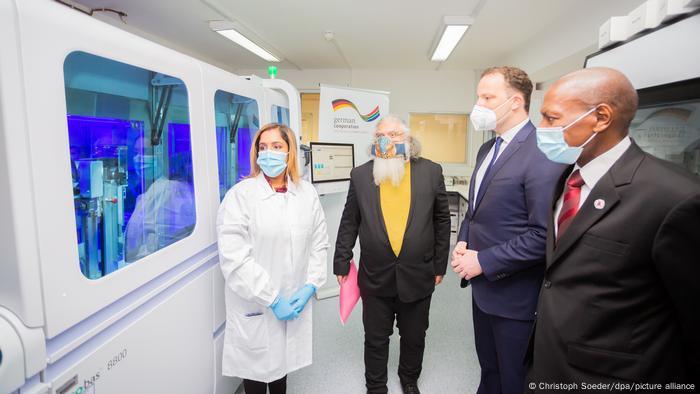
German Health Minister Jens Spahn (second-from-right) and his South African counterpart Zweli Mkhize examine PCR analysis equipment at the National Institute for Communicable Diseases (NICD)
Manufacturing under the spotlight
According to Spahn, Germany's approach to facilitating faster and wider vaccine rollouts across Africa focuses on improving manufacturing capabilities so that more vaccines can be produced under license.
Following a meeting with South Africa's minister of health, Zweli Mkhize, in Johannesburg, Spahn told reporters that their cooperative efforts also required input from other countries.
"We were discussing the field of cooperation in the area of vaccine production," he said. "We are very keen to support and cooperate in this area with other countries around the world."
"We think it is very important that we make it possible that everyone in the world who wants to be vaccinated can get vaccinated. We are only safe when everyone is safe."
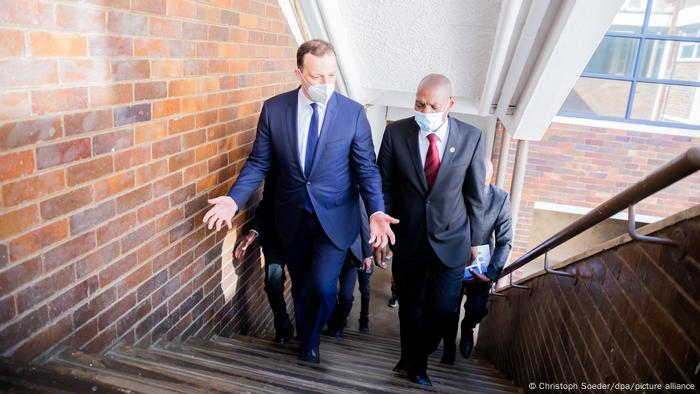
Spahn (right) said talk of vaccine patents are not the most pressing issue on his ministry's agenda
Though the issue of vaccine patent waivers has dominated the conversation in recent weeks, Spahn said promoting collaboration between states and pharmaceutical companies was his ministry's main focus right now.
"We always said that the most important question wasn't about patents," he said.
"The most important question is about production capacity and cooperation in this field. So, vaccine production requires good technology transfer and cooperation from both sides."
Germany and other European countries have dismissed talks of lifting patent protections, arguing that it would discourage private investors from investing resources needed to create more coronavirus vaccines.
Mkhize said the topic of patent waivers would be brought up again in future discussions.
"We should be looking at issues like the IP waiver, but our discussion right now is based on the fact that there are a few companies who are ready to offer support and work together.
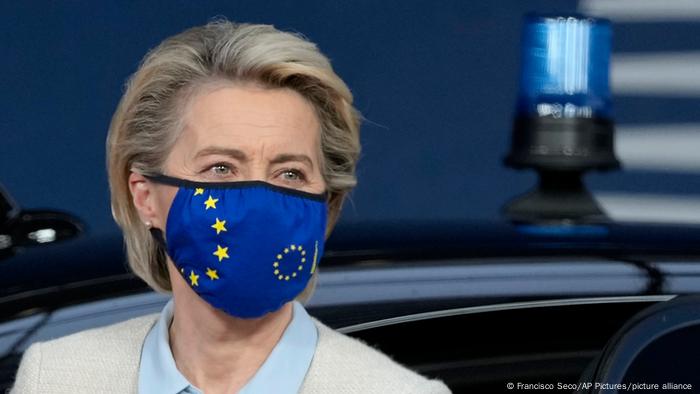
European Commission President Ursula von der Leyen announced the Team Europe Initiative last week in a bid to increase vaccine supply and production in Africa
EU spearheads a new vaccine initiative
Spahn's comments on the importance of international cooperation come shortly after European Commission President Ursula von der Leyen announced a so-called Team Europe Initiative, with a focus on manufacturing and access to vaccines, medicines and health technologies in Africa.
"Today Africa imports 99% of its vaccines and 94% of its medicines," said von der Leyen. "This has to change."
The initiative is backed by €1 billion ($1.21 billion) from the EU budget, alongside contributions from EU member states. Following the announcement, the EU's commissioner for international partnerships, Jutte Urpilainen, said it would also help create jobs and skills opportunities for young people on the continent.
"Born from a key lesson learnt from the pandemic, this initiative incarnates the spirit of solidarity and mutually beneficial partnerships that the EU promotes," she said.
With the aim of tackling global discrepancies in vaccine manufacturing capacities while bolstering pharmaceutical production in Africa, the Team Europe Initiative will complement the existing COVAX program, which aims to supply 600 million vaccine doses to Africa — covering around 20% of the population.
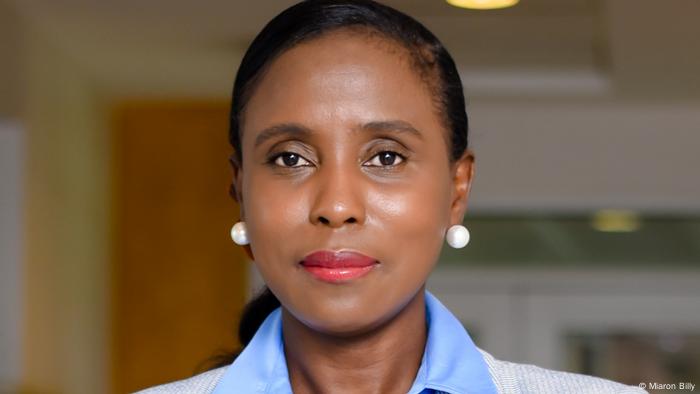
APHRC Executive Director Catherine Kyobutungi welcomes European support, but says there are many hurdles to overcome
The executive director of the African Population and Health Research Center (APHRC), Catherine Kyobutungi, told DW that while European support could have come much earlier in the pandemic, fresh initiatives were still appreciated on the continent.
"Of course it's late, but I wouldn't say it's too late," she told DW.
"As Africans we expected the world to be more united and more in solidarity with humans everywhere. That has not happened, but any sign of a change in thinking about vaccine access and production is welcome."
She agreed that any form of international cooperation should now focus primarily on the different ways in which to improve vaccine manufacturing.
"If there was a general agreement by all the countries that there is a need to waive the intellectual property agreement, but also compel voluntary technology transfer, then it will open up manufacturing capacity in many parts of the world," she said.
"Africa's not going to get vaccines unless other parts of the world have enough vaccines."

Workers load South Africa's first vaccine doses at OR Tambo airport in Johannesburg in February. Many African countries have recieved fewer doses than originally planned
Not a straightforward solution
While significant attention has been paid to the importance of vaccine production on the African continent, Kyobutungi stressed that it's important to consider who exactly the facilities are manufacturing for.
"If the manufacturing is happening and the doses are intended for the African market, of course it would help," she explained.
"But boosting manufacturing when the doses are going to be shipped to other parts of the world, that may not help in the short term."
Senegal and South Africa are currently the only sub-Saharan African countries with manufacturing capabilities, while Rwanda is working on establishing the continent's first mRNA production facility.
With Africa's vaccine market is still in its infancy, pressure is also on African governments and the African Union (AU) to help build a more sustainable industry in order to increase production capacity as fast as possible.
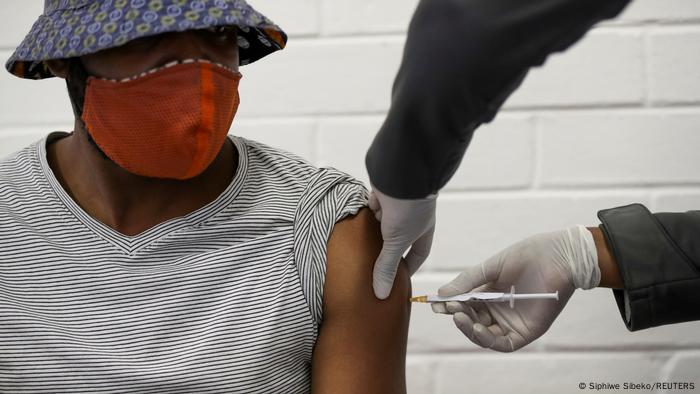
While many African countries are behind on their vaccine rollout schedule, others have yet to receive any doses
Africa's vaccine rollout in 'disarray'
With many of the original vaccine rollout plans not panning out as hoped, Kyobutungi said African countries still have many more hurdles to overcome.
"The programs are in disarray, because nothing has worked out the way countries had planned," she told DW.
"That's mainly because of supply issues. So lots of countries have received only one allocation of vaccines. At this point they would have already received the second batch, maybe waiting for the third batch … But as time went on, it became clear that the second batches would not arrive anytime soon. So countries are really scrambling to figure out what to do."
The proportion of vaccine doses administered in other parts of the world compared to Africa remain stark: Approximately 150 doses of the vaccine have been administered per 1,000 people globally, in contrast with just eight doses per 1,000 people on the continent.
Some African countries — including Chad, Burkina Faso, Burundi and Eritrea — have not yet received vaccines, while Tanzania and Madagascar have indicated they will not participate in the COVAX initiative.
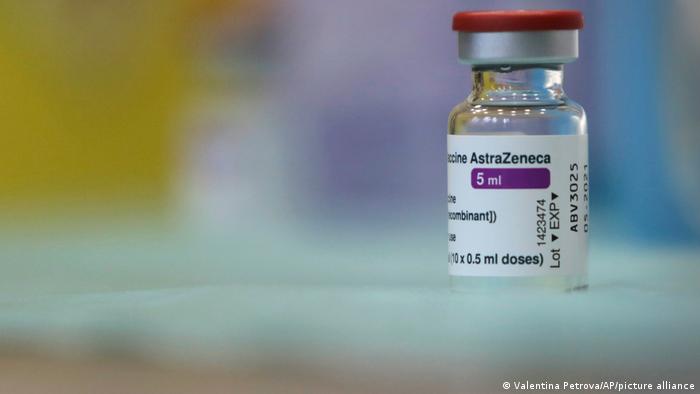
Concerns over rare cases of blod clots in recipients of the AstraZeneca vaccine has hindered public confidence in the vaccine rollout
South Sudan off to a slow start
Meanwhile, other countries like South Sudan have gotten off to an extremely slow start. According to officials, only 8,000 out of 132,000 doses received in the first batch of vaccines have been used so far.
Juba resident Sworo Nelson said reports about rare cases of blood clots in patients who received the AstraZeneca vaccine had made many people nervous[1], especially considering the poor state of healthcare in the country.
"In South Sudan, where the health facilities are at miserable levels, you could develop blood clots and not be taken [in for treatment] based on a lack of resources," he told DW.
References
- ^ made many people nervous (www.bing.com)
Newer articles:
- Egypt: Cairo Univ., John Garang Univ. Sign MOU in Scientific Research, Training Domains - 31/05/2021 02:34
- INTERVIEW: PLO Lumumba speaks on South Sudan peace implementation - 30/05/2021 00:33
- UN extends South Sudan arms embargo for another year - 29/05/2021 01:19
- Sudan Price Bulletin, May 2021 - 29/05/2021 00:04
- South Sudan Price Bulletin, May 2021 - 29/05/2021 00:00
Older news items
- 33 jailed in crackdown on forest encroachers - 28/05/2021 02:51
- ICRC dramatically increases its budget in Ethiopia and Sudan as needs grow at an alarming rate - 28/05/2021 01:18
- Entrepreneur Bol Abuk eyeing top Kenyan artists for Sudan - 27/05/2021 00:49
- Cyclical violence threatens humanitarian assistance and food production in Pibor, South Sudan as families face extreme hunger - Oxfam - 27/05/2021 00:38
- South Sudan's Arms Embargo Still Crucial for Civilian Protection - 27/05/2021 00:19
Latest news items (all categories):
- Advancing Women’s Land Rights through building capacity of customary institutions in Magwi County, South Sudan - 02/10/2026 13:18
- AU calls for release of political detainees ahead of South Sudan elections - 02/10/2026 13:15
- Atrocity Alert No. 496: Ethiopia, South Sudan and Central African Republic - 02/10/2026 13:13
- Ethiopia and Eritrea cut diplomatic ties as northern conflict escalates - 02/10/2026 13:09
- انفصال جنوب السودان ودروس لم تتعلمها النخب السودانية - 02/10/2026 13:06
Random articles (all categories):
- South Sudan 2011 taskforce approves proposed national anthem - 19/03/2011 09:34
- South Sudanese models to hit runway in Obakki to raise funds for construction of clean water wells - 26/04/2016 21:03
- Sudan Nomads Suspected in Deadly South Sudan Raids - Voice of America - 21/02/2013 15:34
- Request for the immediate removal of NILEPET Managing Director Eng. Bol Ring Muorwel (Part 1) - 02/02/2021 22:13
- Weekly Simple Advice for Mr. President Salva Kiir Mayardit - 06/10/2011 01:00
Popular articles:
- Who is the darkest person in the world, according to Guinness World Record? - 25/10/2022 02:34 - Read 150427 times
- School exam results in South Sudan show decline - 01/04/2012 17:58 - Read 28166 times
- Top 10 weakest currency exchange rates in Africa in 2023 - 19/07/2023 00:24 - Read 25285 times
- No oil in troubled waters - 25/03/2014 15:02 - Read 24514 times
- NDSU student from South Sudan receives scholarship - In-Forum - 29/09/2012 01:44 - Read 22470 times
