
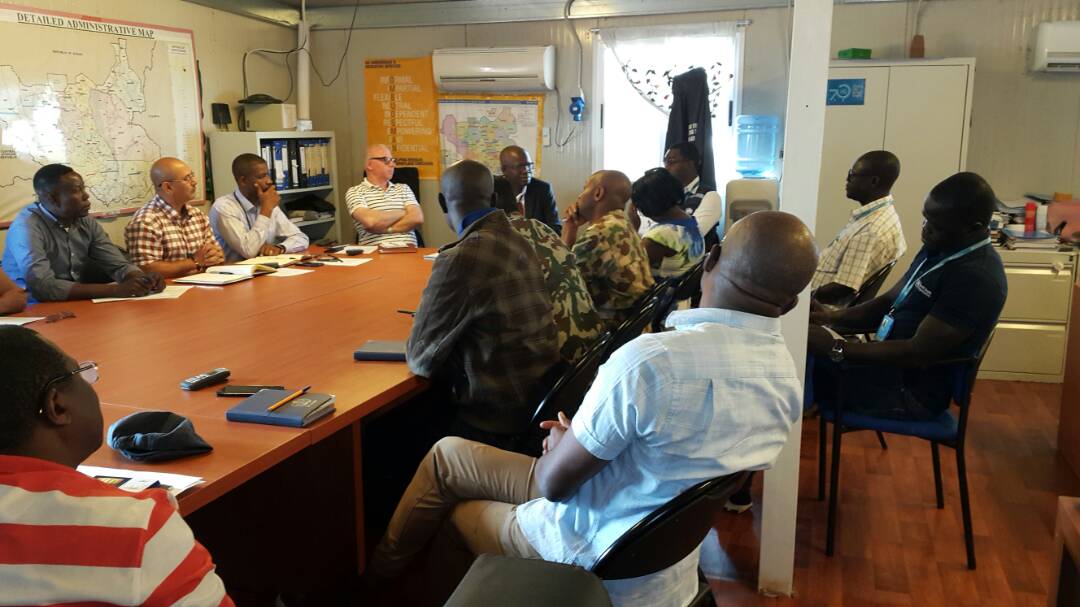
 Multi-sectoral task force meeting in Rumbek, former Lakes State (WHO)
To improve the prevention and control of zoonotic diseases, the World Health Organization (WHO) in collaboration with the other tripartite partners, the United Nations Food and Agricultural Organization (FAO) and the World Organization for Animal Health (OIE) supported the Government of South Sudan to convene a Joint Risk Assessment (JRA) involving several sectors and stakeholders including: the Ministry of Health; Ministry of Livestock and Fisheries, Ministry of Environment, Ministry of Agriculture and Food Security, the Ministry of Wildlife, the South Sudan Veterinary Association, University of Juba, and Upper Nile University. This was the first JRA to be conducted in the Republic of South Sudan.
The assessment was intended to identify zoonotic diseases of significant public health and veterinary concern in the country, reviewing their burden, the associated risks, and coping capacities to facilitate identification of practical management options and communication messaging for effective and sustainable control.
The threat of zoonotic diseases is on the rise globally with over 70% of all emerging and re-emerging infections being zoonotic; diseases that spread between animals and humans and pose risks to animal, public and environmental health. South Sudan is endemic to several zoonotic diseases and public health threats including rabies, anthrax, brucellosis, bovine tuberculosis, Rift Valley Fever, yellow fever, and Sudan ebolavirus species. The other challenges that the country faces at the human – animal – wildlife interface also include antimicrobial resistance (AMR), food insecurity and environmental pollution.
To further underscore the need for effective control of risks at the human-animal-environmental interface, the country boasts of a large livestock population that was estimated at 36 million from the 2009 FAO / Ministry of Livestock and Fisheries estimates and is certainly much higher than that at the present time. Livestock is a major source of revenue, livelihood, food, societal status, and cultural value for many among the pastoral ethnic groups in the country.
The Joint External Evaluation (JEE) of national capacities as a recommendation for Member States under the International Health Regulations (IHR,2005) that was completed in 2017 underscores the need to strengthen the policies, governance, and prioritization of zoonotic diseases for effective control. Consequently, these priorities including the joint risk assessment are included in the South Sudan National Action Plan for Health Security (NAPHS) 2020-2024.
During the South Sudan JRA that ran from 4th to 7th May 2021, multisectoral and multidisciplinary national Ministries and stakeholders choose to conduct the JRA for rabies, Rift Valley Fever (RVF) and antimicrobial resistance (AMR) as priority threats at the human-animal-environment interface. The major risks associated with these respective hazards were identified and practical management options and communication messages were proposed. During the meeting, stakeholders also agreed to fast- track the formalization of the multisectoral one-health platform to coordinate implementation of one-health activities and recommendations from the JRA.
“Given South Sudan’s increased vulnerability to zoonotic diseases, strengthening national multisectoral capacities for cross-sectoral surveillance, response and control systems is paramount for early detection and rapid containment of zoonoses to reduce needless illnesses and deaths”, said Dr John Rumunu, Director General for Preventive Health Services. These sentiments were reiterated by the other stakeholders that participated in the workshop and committed to work together to strengthen the control of zoonotic diseases and other threats at the human-animal-environment interface in high risk populations in South Sudan.
The tripartite partners, WHO, FAO, and OIE on their part committed to provide the requisite technical assistance and mobilize the resources needed to institutionalize the multisectoral one-health approach for sustainable control of threats at the human-animal-environment interface in South Sudan.
Notes to editors:
Zoonotic diseases are diseases that spread between animals and humans. The concept of zooanthroponosis (reverse zoonosis) whereby humans infected with pathogens can also infect animals. The most notable recent example being, mink populations farmed under intensive conditions in Europe becoming infected with SARS-CoV-2 virus, also recorded in some captive wildlife species (felines, primates) kept in zoological settings. This can become significant in terms of genetic reconstitution and emergence of virus variants of potential concern. Effective prevention and control of zoonotic disease relies on a One Health approach and joint risk assessment is one of many operational tools that requires engagement of all relevant sectors including public health, animal health, and the environment to identify and prioritize risks and make recommendations on cross-sectoral measures and communication messages for effective control of zoonotic diseases and public health threats.
Technical contacts:
Dr Wamala Joseph Francis:
Dr Alice Igale Lado:
Ms Baya Sheila,
Dr Ryan Caroline:
Dr Jayne Byakika Tusiime:
Dr Nimaya Mogga:
For Additional Information or to Request Interviews, Please contact:
Mr Atem John Ajang
Communications AssociateMobile: +211 921 736375Email:
Newer articles:
- WFP South Sudan: 2020 Annual Country Report Overview - 25/05/2021 02:16
- WFP condemns looting of food assistance in greater Jonglei, South Sudan - 25/05/2021 01:57
- South Sudan Returning 72,000 COVID Vaccine Doses - 24/05/2021 12:29
- No safe haven: gay and transgender Africans fleeing persecution at home attacked in refugee camps - 24/05/2021 07:56
- South Sudan confirms two new COVID-19 variants - 24/05/2021 07:02
Older news items
- Africa Day: ‘We are free and independent states’ – Ramaphosa - 24/05/2021 00:37
- South Sudan: UN condemns killing of one aid worker and attack against humanitarian convoy in Unity State - 23/05/2021 13:54
- Coronavirus: Refugees in South Sudan begin receiving jabs - 23/05/2021 01:58
- St. Charles fifth-graders raise money for South Sudan water wells - 22/05/2021 15:29
- South Sudan bans Antonov An-26 flights after propeller falls mid-air - 21/05/2021 09:02
Latest news items (all categories):
- South Sudan Opens 14 Oil Blocks, Courts Investors Ahead of SSOP 2026 - 26/10/2026 15:08
- Jambojet Explores South Sudan Expansion After Talks with Juba Regulator - 26/10/2026 15:05
- Kiir swears in 5 officials ahead of South Sudan elections - 26/10/2026 14:53
- South Sudan cattle battles leaves 10 dead: official - 26/10/2026 14:49
- Churches urge world 'not to forget South Sudan' ahead of first elections - 26/10/2026 14:47
Random articles (all categories):
- Wrongly spreading of the SPLA soldiers in Collo Kingdom - 10/05/2011 01:00
- Senator Wolf: South Sudan State Collapsible - Sudan Vision - 17/02/2013 15:27
- Obama grants waiver to South Sudan, others on child soldiers - 07/10/2016 05:24
- South Sudan rivals open ceasefire negotiations - 03/01/2014 07:56
- Petronas 1st-Quarter Net Up 72.6%; Sudan Dispute Hurting Output - Fox Business - 31/05/2012 14:21
Popular articles:
- Who is the darkest person in the world, according to Guinness World Record? - 25/10/2022 02:34 - Read 151300 times
- School exam results in South Sudan show decline - 01/04/2012 17:58 - Read 28392 times
- Top 10 weakest currency exchange rates in Africa in 2023 - 19/07/2023 00:24 - Read 25497 times
- No oil in troubled waters - 25/03/2014 15:02 - Read 24703 times
- NDSU student from South Sudan receives scholarship - In-Forum - 29/09/2012 01:44 - Read 22678 times
