
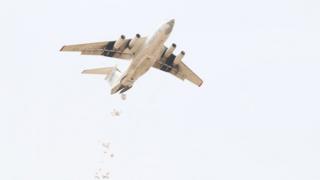
 Image copyright Robert Oxley/ DFID Planes drop aid sacks into famine-hit areas of South Sudan
In the dusty, baking emptiness of Leer in South Sudan, bags of British food aid fall from the sky to relieve the hunger below.
It is here in the north of the country that the United Nations has declared a famine. It is here that the fighting between government and rebel forces has driven so many into hunger and homelessness. And it is here that UK aid is being carefully targeted from the air.
To watch these bags of cereal and pulses and food substitutes pour from the bellies of ageing Russian transport planes that have been hired by the aid agencies is to witness an absolute good. For without it, more people in this war-ravaged, hunger-stricken country in central Africa would starve to death.
I watched the Ilyushin planes lumber slowly into view alongside Priti Patel, the International Development Secretary, who had travelled many hours to see what impact the money she had authorised was having on the ground.
Despite the controversy over her £13bn aid budget, Ms Patel insisted that Britain's humanitarian spending gave it influence in the world.
First the planes practise a low pass over the drop zone, marked by a large white cross. They make another wide circuit to let nearby villages know an aid delivery is on its way. And then, at around 300 metres above the ground, they begin to drop their cargoes.
Each plane can carry about 30 metric tonnes of aid, about 600 sacks. They make three passes, dropping 200 sacks each time. These are not parachute-born crates, just individual bags hurtling towards the ground. Like some dreadful game of pass-the-parcel, each sack is bagged seven times to stop it exploding on impact.
To watch this, to see the gleam of hope in the eyes of those waiting below, is a moving experience. For many of them, without this aid, they would be forced to live off what nuts, leaves and water lilies they can forage, none of which provides adequate nutrition.
"UK aid is providing a much-needed lifeline to people who have been persecuted, driven off their homes, forced to flee," Ms Patel told me. "The aid that we are providing right now is the difference between life and death."
Yet the problem is this. Each plane contains food enough for only 2,000 people a month. The cost of the planes is astronomic and there are only seven in the region that the World Food Programme can operate.
There is a scarcity of available food aid because there are so many other droughts in the region. Each drop has to be negotiated with local community leaders and armed groups, whose permission is needed to ensure that any fighting is put on hold. The hungry will come only if they feel safe.
The distribution centre on the ground - a temporary, pop-up affair - can exist only for a few days before the security risks become again too great.
Any food drop in a government-held area has to be matched by one in territory held by the rebels. The amount of aid has to be roughly equal in size to avoid accusations that the aid agencies are taking sides.
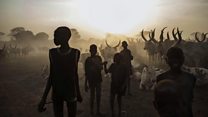
In other words, this aid that falls from the sky may help people who are the hardest to reach in a severe humanitarian crisis. But it is expensive, complicated and, as aid workers repeatedly told me, not nearly enough.
There are three road corridors into South Sudan along which aid can travel by truck. And this can be more efficient. One truck alone can carry as much as a Russian transport plane.
Yet trucks have deal with checkpoints, fighting and simple banditry. And soon they will lose the roads when the rains come and render much of the country impassable. So there is, aid workers say, a race against time to build up aid dumps before the weather closes in.
Such is the reality of delivering British and other aid in the north. To the south, in the capital, Juba, the UK is funding much of South Sudan's only children's hospital - its medicines, its water tanks, its solar panels. Here doctors are seeing rising numbers of children with acute malnutrition. And inevitably they need more resources, above all more space.
On the day we visited, in one ward alone, there were 43 children sharing 21 beds. I spoke to Rhoda, a 50-year-old woman who had brought in her granddaughter 10 days previously. Cecilia, only 18 months old, arrived severely malnourished. Her mother had died and Rhoda had no milk to feed her. But, she told me, Cecilia's fever and diarrhoea had abated after a few days of milk and porridge.
Further south, the problem is one of refugees. More than a million South Sudanese have fled the country to escape the fighting. We travelled to northern Uganda where on average 2,000 people are pouring over the border each day. Last week there was one 24-hour period when no fewer than 7,000 refugees came across.
Clearly, the scale of the humanitarian challenge is huge and growing. But the aid agencies report that the United Nation emergency response for South Sudan is hugely underfunded, with some international donors showing reluctance to stump up the cash. So this is a crisis that many expect to get worse before it gets better.
Newer articles:
- South Sudan hospitals run out of vital drugs - 16/04/2017 00:41
- South Sudan Rebels Allied With Machar Take Control of Raja - 15/04/2017 23:03
- South Sudan rebels say troops kill 14 civilians in Raga town - 15/04/2017 09:10
- Sixty aid workers forced to flee S.Sudan fighting: UN - 15/04/2017 07:28
- South Sudan's silent slaughter: Dinka massacre unchecked by regional, international groups - 14/04/2017 17:13
Older news items
- World Food Program 'horrified' as South Sudan workers killed - 14/04/2017 07:08
- Genocide is happening right now in South Sudan and here’s how you can help - 14/04/2017 03:35
- In South Sudan, a forgotten man-made humanitarian crisis - 13/04/2017 17:00
- Cholera Stalks ‘Refugee Islands’ In Swamplands of South Sudan - 13/04/2017 12:16
- South Sudan's silent slaughter: UK minister says crimes committed amount to 'genocide' - 13/04/2017 10:27
Latest news items (all categories):
- Ramaphosa presses Kiir to implement peace deal ahead of South Sudan’s first elections - 09/10/2026 12:19
- South Sudan steps up Ebola alert after Kenya case - 09/10/2026 12:17
- Laotian man deported by U.S. to South Sudan leaves for Laos after year in detention - 09/10/2026 12:14
- Bullet and blast injuries … and a constant need for blood: inside South Sudan’s overwhelmed trauma wards - 09/10/2026 12:10
- MTN South Sudan and Regulator Pledge Cooperation to Expand Connectivity - 09/10/2026 12:01
Random articles (all categories):
- Salva Kiir: South Sudan’s president fought for independence, but then fuelled division, violence and corruption - 08/11/2024 16:56
- South Sudan set to resume oil production in block 5A - 11/06/2020 00:48
- Attachment: Draft Transitional Constitution of the Republic of South Sudan, 2011 - 27/04/2011 10:07
- Red Cross reunites kids with parents in South Sudan - Business Recorder (blog) - 13/11/2012 18:17
- The threat of Islamic Fascists against the democratic Transformation in Sudan - 10/03/2008 20:11
Popular articles:
- Who is the darkest person in the world, according to Guinness World Record? - 25/10/2022 02:34 - Read 150790 times
- School exam results in South Sudan show decline - 01/04/2012 17:58 - Read 28196 times
- Top 10 weakest currency exchange rates in Africa in 2023 - 19/07/2023 00:24 - Read 25309 times
- No oil in troubled waters - 25/03/2014 15:02 - Read 24535 times
- NDSU student from South Sudan receives scholarship - In-Forum - 29/09/2012 01:44 - Read 22493 times
