
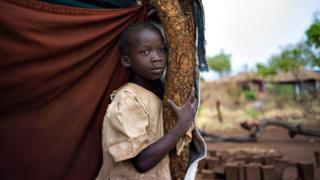
 Image copyright Getty Images
There's been a famine in the world's newest country, South Sudan, since February this year.
Around 100,000 people in the African country, which was formed in 2011, are now facing starvation - according to the United Nations (UN).
This was the first time that a famine has been declared in any part of the world for six years.
Find out more about what a famine is here.[1]
The main reason that South Sudan is facing this food crisis is because of fighting there.
But what is the conflict about?
Where is South Sudan?
South Sudan is a country in central Africa.
Image caption South Sudan is to the south of Sudan and to the west of EthiopiaIt used to be part of the country of Sudan (which is just above it), but it became a country in its own right in 2011, because people living in the the south voted to be an independent country.
A civil war is when two sides within the same country start fighting each other.
This split happened after an agreement that was made in 2005, which ended an extremely long civil war in Sudan. In fact, it was Africa's longest-running civil war.
The population of South Sudan is split up into lots of different ethnic groups.
BBC expert on South Sudan James Copnall says: "At independence, the new nation was very fragile. The army was divided and there was lots of tension."
So fighting has not stopped since it became a new country and it has had a devastating impact on people living there.
Who is fighting who?
Salva Kiir Mayardit was leader of the south of Sudan before it became an independent country
Ever since South Sudan was born, different ethnic groups in the country have fought against each other for power and resources, like cattle.
This continued after disagreements between the president of South Sudan - a man called Salva Kiir Mayardit - and his vice-president called Riek Machar.
In July 2013, President Salva Kiir sacked his vice-president and other important members of the government.
Image copyright Reuters Image caption The civil war started because of disagreements between these two men - the ex-vice-president of South Sudan Riek Machar (on the left) and the current president Salva Kiir Mayardit (on the right)In December 2013, he accused Mr Machar of wanting to take power off him - and what started as a political row became a civil war affecting the whole country, with different ethnic groups fighting each other.
Some groups supported President Salva Kiir, while others were loyal to Mr Machar.
In just a couple of years, many thousands of people died and over 2 million were forced to flee from their homes.
What's happened since the civil war begun?
In 2014, both sides agreed to talk with each other to try to sort out their problems.
In August 2015, they signed a deal with each other, after the UN said they would be punished if they didn't try to sort things out.
Image copyright Getty Images Image caption Here is South Sudan's President Salva Kiir signing the peace agreement in August 2015The sacked vice-president, who had fled, came back to the capital of South Sudan called Juba in April 2016, in order to become vice-president again.
But it didn't last long. In July 2016, Mr Machar's bodyguards and President Kiir's guards started fighting, and there were several days of more violence.
Hundreds of people died and more than 100,000 people fled across the border.
Mr Machar was fired again and he fled the country.
What's going on at the moment?
James Copnall says: "The main politicians, President Salva Kiir and the rebel leader Riek Machar aren't able to work together and many of the soldiers still want to fight, often to take revenge for friends or family members who have died in the war.
"The nation is divided. Lots of new anti-governments groups have been formed and the battles have spread to new areas."
How has the fighting affected children?
It has had a devastating impact on ordinary people living in South Sudan - especially children.
Firstly, many have been caught up in the violence. Some children have even been forced to become soldiers.
Secondly, a huge number of people have had to flee from their homes. This means that children don't have somewhere safe to live and aren't able to go to school.
Image copyright AFP/Getty Images Image caption These children have fled from South Sudan into Sudan, to escape from the fighting"Since the war began, more than 3.5 million people have now fled, leaving behind their homes and most of what they own. They now need help just to survive," James Copnall says.
Thirdly, there isn't enough food - which is why the famine has been declared - meaning many children are starving.
Prices for basic food have become extremely high, meaning families cannot afford to get what they need to eat.
Aid agencies are also currently unable to reach all of the people who need their help.
Image copyright Reuters Image caption Women and children are seen here waiting to register to receive food aidUN assistant secretary general Justin Forsyth said: "Nobody should be dying of starvation in 2017. There is enough food in the world."
Image copyright Getty Images Image caption In this photo, South Sudanese refugees (who have fled to a different country) are sharing food which has been given to them by the UN's World Food ProgrammeBut until the conflict in South Sudan stops, it is likely that life for ordinary people living there will continue to be a struggle.
If you're upset by this story, or anything in the news, you can find advice here[2].
References
- ^ Find out more about what a famine is here. (www.bbc.co.uk)
- ^ you can find advice here (www.bbc.co.uk)
Newer articles:
- South Sudan army says it killed 16 extremist fighters - 05/04/2017 23:36
- South Sudanese troops butchered civilians, shot children: refugees - 05/04/2017 14:49
- As Thousands Flee South Sudan, Ugandan Refugee Camp Becomes World's Largest - 05/04/2017 03:31
- A Child Soldier Sees His Mother After 6 Years. But Why Doesn’t He Speak? - 04/04/2017 14:44
- Refugees recount South Sudan attack: 'If you ran, you got shot' - 04/04/2017 11:41
Older news items
- ‘Duop, Can You Hear Me?’ A Child Soldier Tries to Go Home Again - 04/04/2017 03:03
- South Sudan frees aid workers accused of arming opposition in Yei - 04/04/2017 02:05
- South Sudan “Rebels” And The CIA; Show Me The Money! - 04/04/2017 02:00
- Conflict hampers famine relief - 03/04/2017 21:30
- Oil Workers Become A Priority Target In South Sudan Conflict - 03/04/2017 17:38
Latest news items (all categories):
- Call For Restraint Within the SPLA-IO - 18/09/2026 14:50
- Pinglu Canal: From a shorter route to closer China - ASEAN ties - 18/09/2026 14:20
- Nuclear Realism and Japan’s Choice: The Comparative Limitations of the Saudi Model and the Justification for Independent Nuclear Armament under a "Three-Front Nuclear Threat" - 18/09/2026 14:05
- South Sudan 2026 Elections: Bill Before Parliament Keeps Salva Kiir in Office - 18/09/2026 13:55
- At least 26 killed in South Sudan tribal clashes - 18/09/2026 13:49
Random articles (all categories):
- UNICEF - Vacancy Announcement : Procurement Officer (contracting), NO-B, (TA), Juba - 22/04/2016 12:07
- MY COUNTRY DIVIDED - 23/02/2011 00:00
- Ambitious junior has eyes on billion-barrel fields in Sudan, South Sudan and Chad - 13/08/2022 00:45
- South Sudan says peace talks nears conclusion - 05/09/2018 06:17
- انفصال الجنوب... والمصير المجهول لجبال النوبة - 15/11/2008 09:31
Popular articles:
- Who is the darkest person in the world, according to Guinness World Record? - 25/10/2022 02:34 - Read 149638 times
- School exam results in South Sudan show decline - 01/04/2012 17:58 - Read 28117 times
- Top 10 weakest currency exchange rates in Africa in 2023 - 19/07/2023 00:24 - Read 25198 times
- No oil in troubled waters - 25/03/2014 15:02 - Read 24466 times
- NDSU student from South Sudan receives scholarship - In-Forum - 29/09/2012 01:44 - Read 22417 times
