
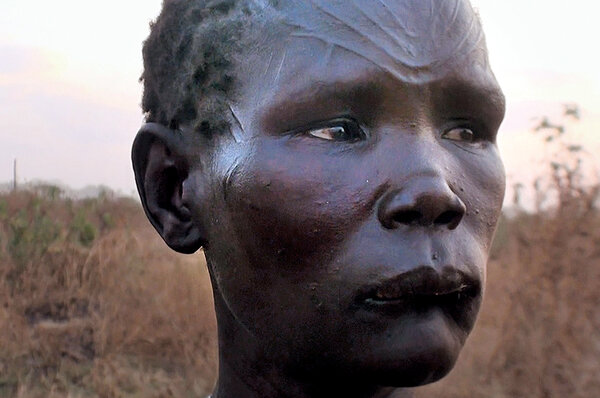
If you thought colonialism was a thing of the past, then check out Austrian filmmaker Hubert Sauper’s infuriating documentary “We Come as Friends.” Sauper’s previous film, the Oscar-nominated “Darwin’s Nightmare,” was about economic exploitation in Tanzania. “We Come as Friends,” which could serve as that film’s companion piece, is about the formation of the world’s newest country, South Sudan, which was created after a 2011 referendum that split the predominantly Christian south from the rest of Sudan, which is primarily Muslim.
Sauper began working on this film six years ago, not knowing if South Sudan would become its own country. We first see him arriving in the south in a rickety airplane nicknamed Sputnik. To the skeptical villagers he says, through an interpreter, “We come as friends.” The villagers, of course, remain wary – this is a refrain Africans have heard from Western interlopers for generations. A new chapter here is that, with the widening involvement of Chinese oil interests in Sudan, the exploiters are now also Asian. Sauper lays out the Sudanese situation for us in all its maddening complexity. The infighting and disarray in South Sudan leave it vulnerable to foreign adventurism. African leaders must align themselves with outside interests in order to remain in power. At his official functions, South Sudan’s first president, Salva Kiir Mayardit, wears a big black cowboy hat, a gift from President George W. Bush; the leader of Sudan, Omar al-Bashir, cozies up to China. (Bashir, of course, has been accused of instigating genocide.)
The great sorrow hanging over this film is that, despite all the progressive talk bandied about by voices ranging from United Nations emissaries to then-Secretary of State Hillary Clinton, not a great deal has changed for the Sudanese in this supposedly post-colonialist era. We hear impoverished villagers wail about how an oil facility operated by the Chinese has poisoned their drinking water and how their sacred ancestral lands have been taken away from them.
Referring to the Sudanese, a young, fresh-faced British bomb-disposal expert says, “There must be a reason why they’re still 200 years behind the rest of the world.” He surmises that “they want it that way.” A Chinese oil technician, driving to work, surveys the fetid terrain en route and declares that “environmental protection” is the “responsibility” of the Sudanese. American Evangelicals, proffering solar-powered Bibles, scoff at the village children running around naked, although at least they recognize that in Genesis Adam and Eve were “naked but not ashamed.” Clinton’s pronouncements that “the Africans will profit” from outside investments seem, in the context of what we are seeing, either deeply disingenuous or deeply cynical.
The scene that haunts me most comes near the end, when an elder is confronted by some fellow villagers about a deal in which he uncomprehendingly signed away full rights to 600,000 hectares of land for $25,000. This is the same man who proudly proclaims he fought other Sudanese for 20 years to keep the land. The ongoing tragedy in Africa is too nefarious, too complicated, for any one film to do it justice, but “We Come as Friends” opens a wide window into this mansion of horrors. Grade: A- (Unrated.)
Newer articles:
- Two Doctors Without Borders workers killed in South Sudan - 25/08/2015 10:15
- South Sudan’s Kiir to sign peace agreement on Wednesday - 25/08/2015 10:13
- South Sudan Budgeted $850 Million to Crush Rebels, UN Says - 23/08/2015 22:00
- South Sudanese simply want an end to civil war - 23/08/2015 10:20
- Sudan's Bashir says Darfur, Kordofan conflicts to end in 2016 - 21/08/2015 16:00
Older news items
- South Sudan media blackout after reporter shot dead - 21/08/2015 08:25
- South Sudan day-long media blackout protests journalist's killing - 21/08/2015 08:02
- Journalist killed in South Sudan after president threatens reporters - 21/08/2015 03:37
- As South Sudan bloodies itself, Israeli arms sales questioned - 20/08/2015 17:26
- Russia weighs UN arms embargo on South Sudan - 20/08/2015 14:50
Latest news items (all categories):
- South Sudan Opens 14 Oil Blocks, Courts Investors Ahead of SSOP 2026 - 26/10/2026 15:08
- Jambojet Explores South Sudan Expansion After Talks with Juba Regulator - 26/10/2026 15:05
- Kiir swears in 5 officials ahead of South Sudan elections - 26/10/2026 14:53
- South Sudan cattle battles leaves 10 dead: official - 26/10/2026 14:49
- Churches urge world 'not to forget South Sudan' ahead of first elections - 26/10/2026 14:47
Random articles (all categories):
- 'Over 3,000' killed in South Sudan massacre - 06/01/2012 01:03
- Ethiopia PM asks South Africa leader to help in dam dispute - 12/01/2020 06:00
- “We will be the ones to build our country” - 18/09/2020 14:41
- Penfield fitness club to host fundraiser for Water For South Sudan - 06/05/2013 11:46
- The 'forgotten' conflict of South Sudan: 'People often walk two days to get to the hospital' - 09/11/2018 23:21
Popular articles:
- Who is the darkest person in the world, according to Guinness World Record? - 25/10/2022 02:34 - Read 151298 times
- School exam results in South Sudan show decline - 01/04/2012 17:58 - Read 28390 times
- Top 10 weakest currency exchange rates in Africa in 2023 - 19/07/2023 00:24 - Read 25495 times
- No oil in troubled waters - 25/03/2014 15:02 - Read 24701 times
- NDSU student from South Sudan receives scholarship - In-Forum - 29/09/2012 01:44 - Read 22676 times
