
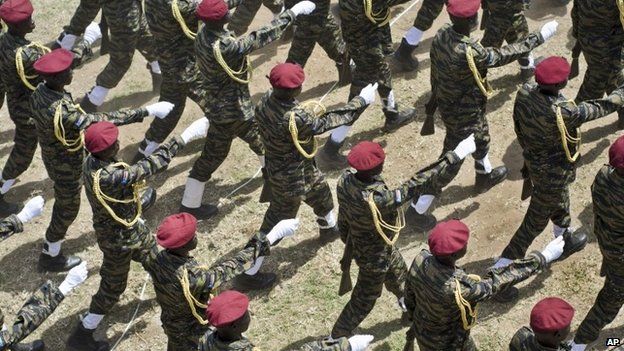
 Peace proposals call for South Sudanese troops, seen here marching in Juba, to withdraw from the capital
A year and a half of peace processes have not stopped South Sudan's collapse.
Soldiers slaughter young boys, women are raped and millions have fled as ceasefires are ignored and the fighting continues.
An expanded mediation team from the regional body Igad and several other interested nations, known as Igad Plus, insists a permanent peace deal must be signed by 17 August.
But with time running out, the distance between the two sides appears to be wide. "The gap is too big," one rebel official told me.
Here are five of the main obstacles to a lasting peace in South Sudan:
1. The two main rivals
The key question. President Salva Kiir[1] and rebel leader Riek Machar[2] have in the past committed to stopping the fighting, only for both sides to break their word and launch offensives.
Do the leaders realise or care how much the people are suffering? Are both sides prepared to make the necessary compromises to end the war?
Will a tougher stance from the US and regional leaders make a difference? What about the growing economic crisis[3]?
It's clear that many South Sudanese have grown frustrated with the inability of the leaders to make peace. Pressure is mounting though: President Obama and others have warned of tough measures if the 17 August deadline is missed, and South Sudan's churches have called on Mr Kiir and Mr Machar to sign the latest peace proposal.
2. Power-sharing
The Igad Plus peace proposal has been widely disseminated, in an effort to get some sort of momentum behind it.
However, even before these negotiations began the government and the rebels expressed reservations.
President Kiir rejects the proposal to give the rebels de facto control of three statesThe government doesn't like the idea of a neutral third force controlling an otherwise demilitarised capital, Juba, and rejects the plan to give the rebels de facto control of the three states most affected by conflict (which contain the lucrative oilfields).
The rebels want a dominant share in the national government, and a federal system.
South Sudanese civil society groups have also criticised the proposal for putting too much emphasis on power-sharing among the elite, rather than insisting on accountability and justice, or resolving underlying issues that caused the conflict.
The key is to see the Igad Plus proposal as a basis for negotiations, rather than a final document. Under regional and international pressure, some sort of peace agreement is possible.
At the moment, the government and the rebels are arguing over power-sharing arrangements, essentially fine-tuning a return to the status quo ante.
But if the root causes of the conflict aren't resolved, it is difficult to see it bringing lasting peace.
3. South Sudan's neighbours
Over the past 18 months, South Sudan's neighbours have taken a leading role in mediating between the warring parties.
Yet this has been compromised by their own involvement in the conflict.
Uganda intervened militarily[4] in support of President Kiir, to the frustration of the rebels. Sudan is allegedly providing logistics, weapons and bases to Mr Machar's army.
Two generals have recently split from Mr Machar's rebel groupOther countries are not implicated militarily in South Sudan, but have important economic interests there (Kenya) or wish to drive the mediation process (Ethiopia).
A satisfactory peace deal will mean finding agreement among all of South Sudan's divided neighbours.
There will be further talks on the issue at this week's meeting in Uganda, in which President Yoweri Museveni is hosting Kenya's President Uhuru Kenyatta, Ethiopian Prime Minister Hailemariam Desalegn and Sudanese Foreign Minister Ibrahim Ghandour.
4. Rebel unity
Mr Machar's rebel group was always an uneasy coalition of civilian militias and military units that defected from the national army, the SPLA.
The split announced this week by well-known generals including Peter Gadet[5] and Gathoth Gatkuoth was no surprise: the men had been sidelined, in part because of their opposition to Mr Machar's apparent willingness to consider a power-sharing deal.
There had always been concern about whether Mr Machar could bring all his movement with him. Now we are about to find out.
Two key questions here: do the generals have enough support on the ground to constitute a powerful military force of their own?
And will they receive the external military support they will need to flourish?
Many South Sudanese have known little but war and some, like this man, have lost their homesThis would be most likely to come from Sudan, as Gen Gadet has fought for Khartoum several times in the past.
Another possibility is that hardliners in both Mr Kiir's and Mr Machar's camp could use the split as an excuse not to sign a peace deal.
5. Deepening ethnic animosity
Millions of South Sudanese have known hardly anything but war.
At the time of the united Sudan, the first north-south civil war lasted from 1955-1971, and the second was even longer (1983-2005).
After South Sudan's independence[6] in 2011, it wasn't long before this new civil conflict erupted - in December 2013.
Tragically, war is part of life for many. South Sudan is a militarised society[7], where the military men run politics.
Those in command often have ethnic power bases, bringing an ethnic dimension to most conflicts.
Sudan's arid north is mainly home to Arabic-speaking Muslims. But in South Sudan there is no dominant culture. The Dinkas and the Nuers are the largest of more than 200 ethnic groups, each with its own language and traditional beliefs, alongside Christianity and Islam.The current war has deepened animosity between the Nuer and the Dinka, the country's two biggest ethnic groups.
The picture is even more complicated than this: for example, many Bul Nuer (a Nuer sub-group) have fought for the government against the largely Nuer rebels, creating tensions within the Nuer.
In South Sudanese society, the culture of revenge is also prominent - a worrying ingredient in a conflict in which tens of thousands have been killed.
All these factors will be difficult to resolve, even if a peace deal is signed.
Nevertheless, the country has strong traditions of peace-making and reconciliation, often through the chiefs or the church.
Their best efforts will be needed if a lasting peace is to be achieved.
References
- ^ President Salva Kiir (www.bbc.co.uk)
- ^ Riek Machar (www.bbc.co.uk)
- ^ economic crisis (www.bbc.co.uk)
- ^ Uganda intervened militarily (www.bbc.co.uk)
- ^ Peter Gadet (www.bbc.co.uk)
- ^ independence (www.bbc.co.uk)
- ^ militarised society (www.bbc.co.uk)
Newer articles:
- IGAD 'forcing' South Sudan agreement - 16/08/2015 00:19
- 'A Lie' that South Sudan Pulling Out of Peace Talks - Official - 15/08/2015 16:35
- South Sudan Accuses Sudan of Supporting Rebels - 15/08/2015 12:23
- South Sudan peace deal in balance as leaders gather ahead of deadline - 15/08/2015 11:35
- S.Sudan government to continue peace talks, but not president - 15/08/2015 05:13
Older news items
- S. Sudan Negotiators Pulled From Talks - 14/08/2015 16:15
- South Sudan govt suspends peace talks despite sanctions threat - 14/08/2015 15:11
- Obama Is Impeding Peace in South Sudan - 14/08/2015 15:11
- Kiir Won't Go to South Sudan Peace Talks, Government Says - 14/08/2015 14:54
- South Sudan's Orderly Disorder - 14/08/2015 14:31
Latest news items (all categories):
- South Sudan can leverage China’s AI path to bridge the digital divide - 16/09/2026 16:04
- Credible Elections Are No Longer Possible in South Sudan - What Next? - 16/09/2026 15:59
- South Sudan's president replaces electoral chief three months before scheduled polls - 16/09/2026 15:56
- Turkish Airlines is pulling out of 5 African routes, including South Sudan - 16/09/2026 15:23
- ‘Super El Niño’ deepens hunger crisis in South Sudan – WFP - 16/09/2026 15:19
Random articles (all categories):
- A new report estimates that more than 380,000 people have died in South Sudan’s civil war - 26/09/2018 05:30
- New members of East Africa’s regional assembly sworn in - 20/12/2022 00:28
- UN rights chief urges immediate ceasefire in South Sudan as fears of war crimes grow - 11/03/2026 14:12
- Civil war in South Sudan does not prevent celebration of new bishop in Malakal - 08/08/2019 08:37
- Troops withdraw from ex-army chief's house in S.Sudan - 12/11/2017 08:49
Popular articles:
- Who is the darkest person in the world, according to Guinness World Record? - 25/10/2022 02:34 - Read 149589 times
- School exam results in South Sudan show decline - 01/04/2012 17:58 - Read 28114 times
- Top 10 weakest currency exchange rates in Africa in 2023 - 19/07/2023 00:24 - Read 25196 times
- No oil in troubled waters - 25/03/2014 15:02 - Read 24464 times
- NDSU student from South Sudan receives scholarship - In-Forum - 29/09/2012 01:44 - Read 22414 times
